
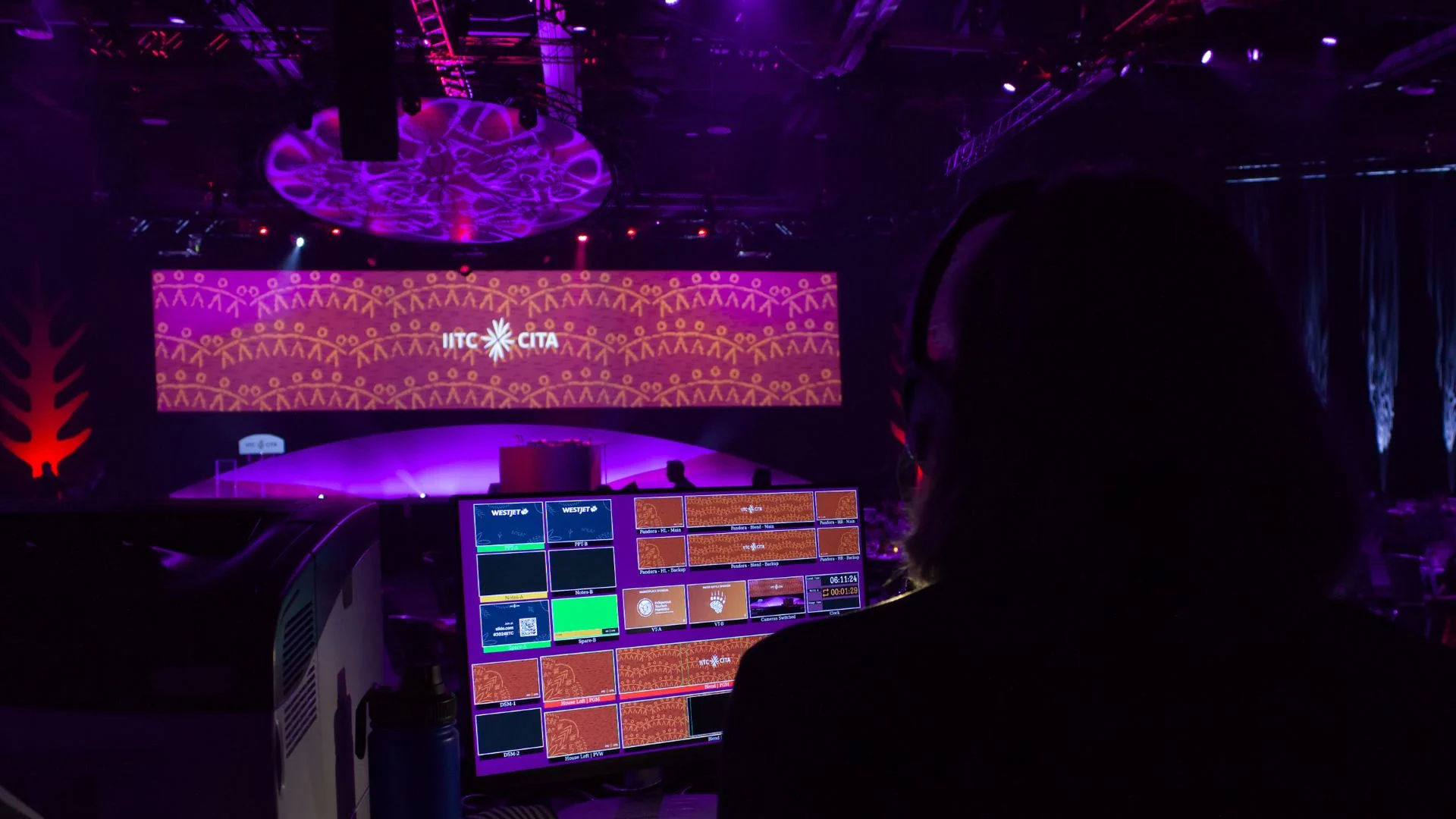
In the world of live event production and corporate audiovisual services, there is often an instinct to solve every challenge with more technology.
More screens.
More lighting.
More sound.
Part of this impulse is commercial; our industry sells equipment and technical services. But I think the deeper reason is that many of us have come to believe that technology itself is the value we bring to an event.
In reality, the opposite is true.
When audiovisual production is done well, you should hardly notice it at all.
The Invisible Role of Event Technology
There is an adage in our industry: if we do our jobs perfectly as live event professionals, the audience should never know we were there.
That doesn’t mean technology isn’t important. Quite the opposite.
Audiovisual production exists to create the conditions where communication is effortless.
Our role in live event production is to determine where the line is, where audio, lighting, video, and staging support the message, amplify the experience, and create an environment where the audience can focus on what matters most.
Nothing more.
Nothing less.
At Avera, we often say that our clients should purchase as much production as necessary and as little as possible. That philosophy has guided our company from the beginning and is one of the reasons our clients trust us to make decisions that are in their best interest.
Good event production isn’t about how much technology is in the room.
It’s about using the right tools in the right way.
The Fundamentals of Audiovisual Production
If we step back for a moment, the purpose of audiovisual technology at a corporate event is actually quite simple.
Audio
Sound systems exist to capture, amplify, and reinforce spoken word, music, and sound effects so that every person in the room can hear clearly.
When audio is done properly, it disappears.
But when it’s done poorly, everyone feels it.
Have you ever walked out of an event feeling exhausted? Often it’s because you spent the entire session straining to hear what was happening on stage, or being overwhelmed by sound that was simply too loud.
Clear, balanced audio is one of the most important foundations of corporate event AV production.
Lighting
Lighting serves a similar purpose.
At its most fundamental level, lighting helps the audience see what is happening on stage. It draws attention to the speaker, separates the focal point from the surrounding environment, and helps create an emotional tone for the event.
Lighting can also support brand identity, create visual aesthetics, and ensure that the stage is safe and comfortable for presenters.
But when lighting becomes the focus, when the audience is distracted by the technology itself, something has gone wrong.
The purpose of event lighting design is not to show off equipment. It is to communicate and guide attention.
Video, Staging, and Event Technology
The same principle applies to the other tools we use in live event production.
Video screens help audiences see content clearly.
Staging creates presence and structure for speakers.
Interpretation ensures language doesn’t become a barrier.
Streaming allows remote audiences to participate.
All of these elements (along with the many tools event planners use to design guest experiences) work together to create an environment where communication is effortless and meaningful.
When the technology disappears and the message shines through, event production is doing its job.
Audiovisual Production Is an Extension of Your Brand
At its best, corporate event production is not about equipment at all.
It’s about communication.
A professional audiovisual production team should function much like a graphic designer or architect. Just as designers use color, shape, and negative space to guide the eye, event production teams use sound, light, staging, and video to guide attention and reinforce meaning.
In that sense, event technology becomes part of how your brand communicates with an audience.
And if the production itself becomes the center of attention, we have probably missed the mark.
Thoughtful Production Matters at Every Scale
One of the misconceptions in our industry is that thoughtful live event production only matters for large conferences or elaborate stage shows.
But in reality, the principles that make an event successful, clarity of sound, thoughtful lighting, effective staging, and intentional use of space, apply just as much to a meeting of 40 people as they do to a room of 2,000.
When the right balance of audiovisual production, event technology, and creative staging comes together, the audience rarely notices the technology itself.
They simply experience an event that feels natural, engaging, and clear.
Because no event that matters is ever too small for thoughtful production.